 Spiritswap
 liquidity pools: vAMM or stable swap?
SpiritSwap pools supply assets for token swaps on Fantom Opera. The relevant choices depend on the assets’ price relationship, the pool version and the rewards attached to that position.
Last updated- Classic vAMM deposits
- Two tokens of equal value, supplied in the pool’s reserve proportions.
- Classic pool ownership
- SPIRIT-LP tokens represent a proportional claim on the pool’s underlying assets.
- V3 ownership
- Concentrated-liquidity positions use a selected price range and a proof-of-provision NFT.
- Farming eligibility
- Supported SPIRIT-LP tokens can enter the documented farm model; emissions, the staked contribution and applicable boosts determine SPIRIT rewards.
Choose the design for the assets
The classic vAMM uses the constant-product relationship between two token reserves. Deposits follow the existing reserve proportions, so equal value does not mean equal token quantities. For a newly created classic pool, its creator establishes the initial token price.
SpiritSwap’s Balanced AMM (V2.1) documentation distinguishes stable math from weighted math. Stable pools target assets that trade near price parity, while weighted pools accommodate different asset relationships and weights beyond a 50/50 allocation.
A V3 position can earn trading fees only while the price stays within its selected range. The Adding Liquidity Guide warns that tighter ranges carry risk from impermanent loss. For a V3 pair involving FTM, that guide specifies WFTM as the token held in the pool.
Read trading fees by model and version
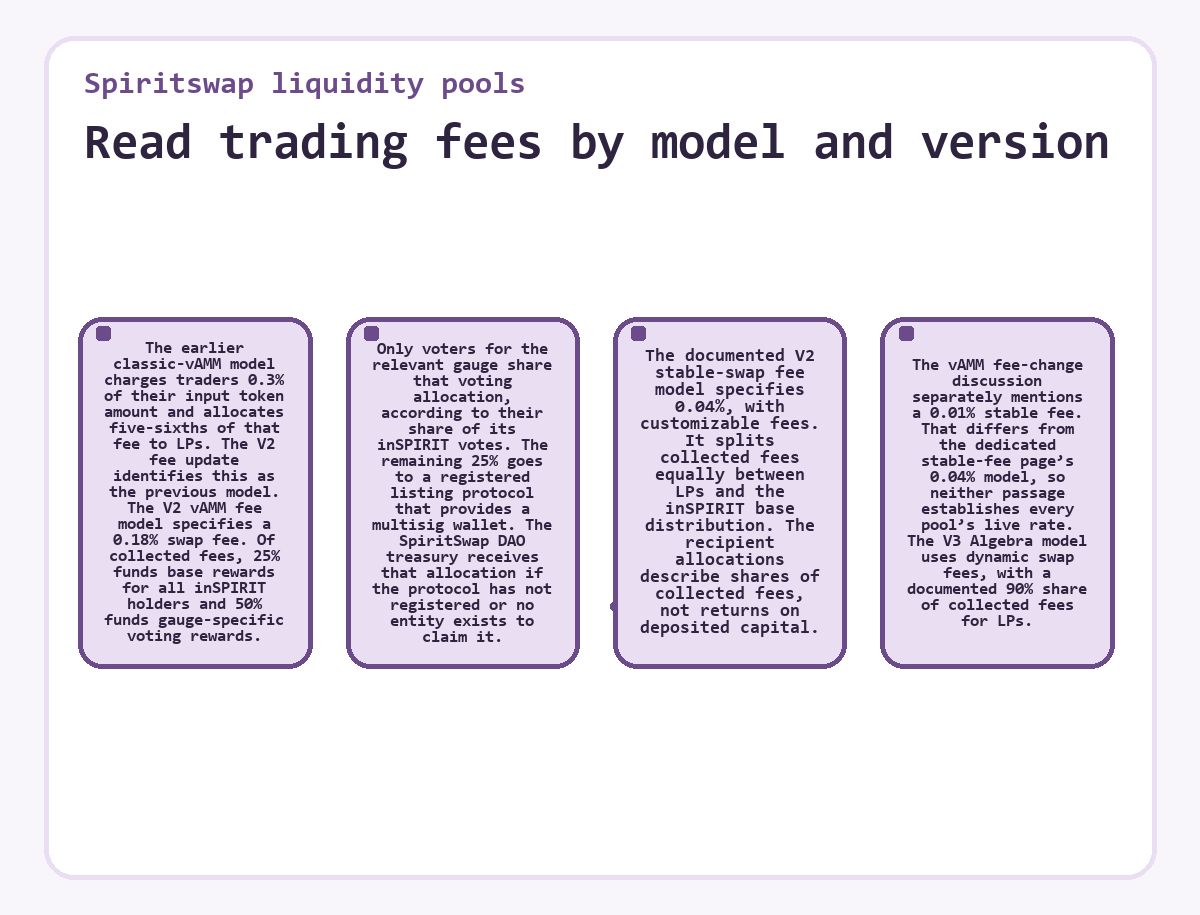
The earlier classic-vAMM model charges traders 0.3% of their input token amount and allocates five-sixths of that fee to LPs. The V2 fee update identifies this as the previous model.
The V2 vAMM fee model specifies a 0.18% swap fee. Of collected fees, 25% funds base rewards for all inSPIRIT holders and 50% funds gauge-specific voting rewards. Only voters for the relevant gauge share that voting allocation, according to their share of its inSPIRIT votes.
The remaining 25% goes to a registered listing protocol that provides a multisig wallet. The SpiritSwap DAO treasury receives that allocation if the protocol has not registered or no entity exists to claim it.
The documented V2 stable-swap fee model specifies 0.04%, with customizable fees. It splits collected fees equally between LPs and the inSPIRIT base distribution. The recipient allocations describe shares of collected fees, not returns on deposited capital.
The vAMM fee-change discussion separately mentions a 0.01% stable fee. That differs from the dedicated stable-fee page’s 0.04% model, so neither passage establishes every pool’s live rate. The V3 Algebra model uses dynamic swap fees, with a documented 90% share of collected fees for LPs.
Separate the pool share from farming rewards
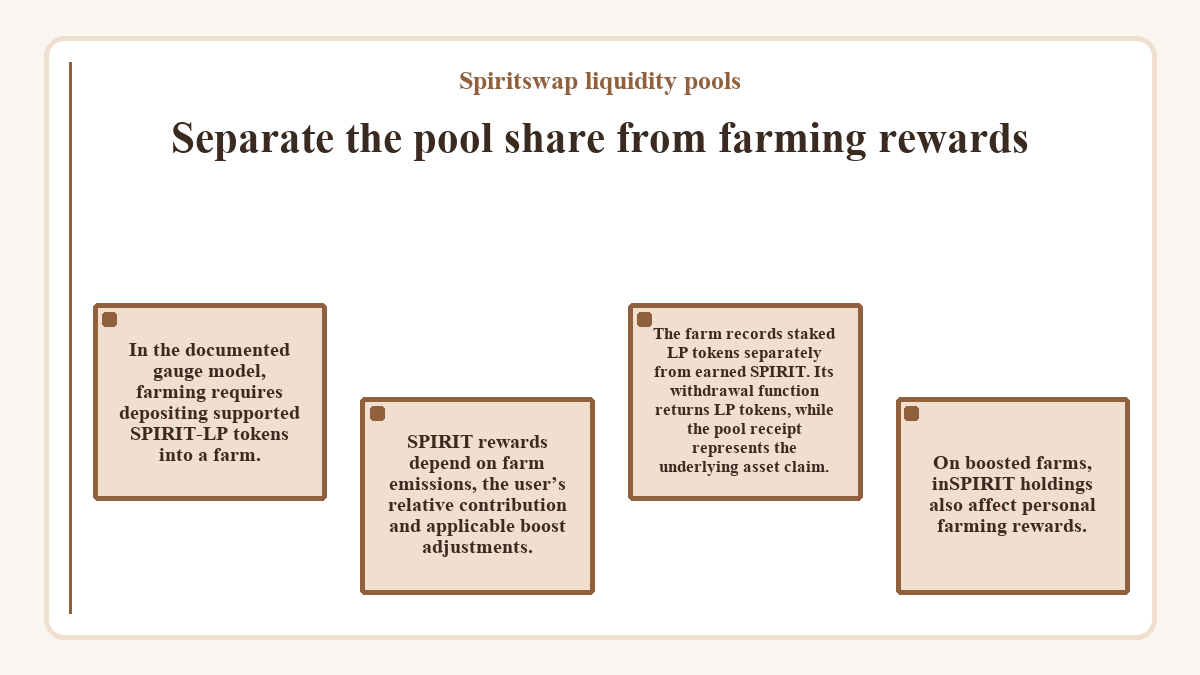
In the documented gauge model, farming requires depositing supported SPIRIT-LP tokens into a farm. SPIRIT rewards depend on farm emissions, the user’s relative contribution and applicable boost adjustments.
The farm records staked LP tokens separately from earned SPIRIT. Its withdrawal function returns LP tokens, while the pool receipt represents the underlying asset claim. On boosted farms, inSPIRIT holdings also affect personal farming rewards.
Pool decision checklist
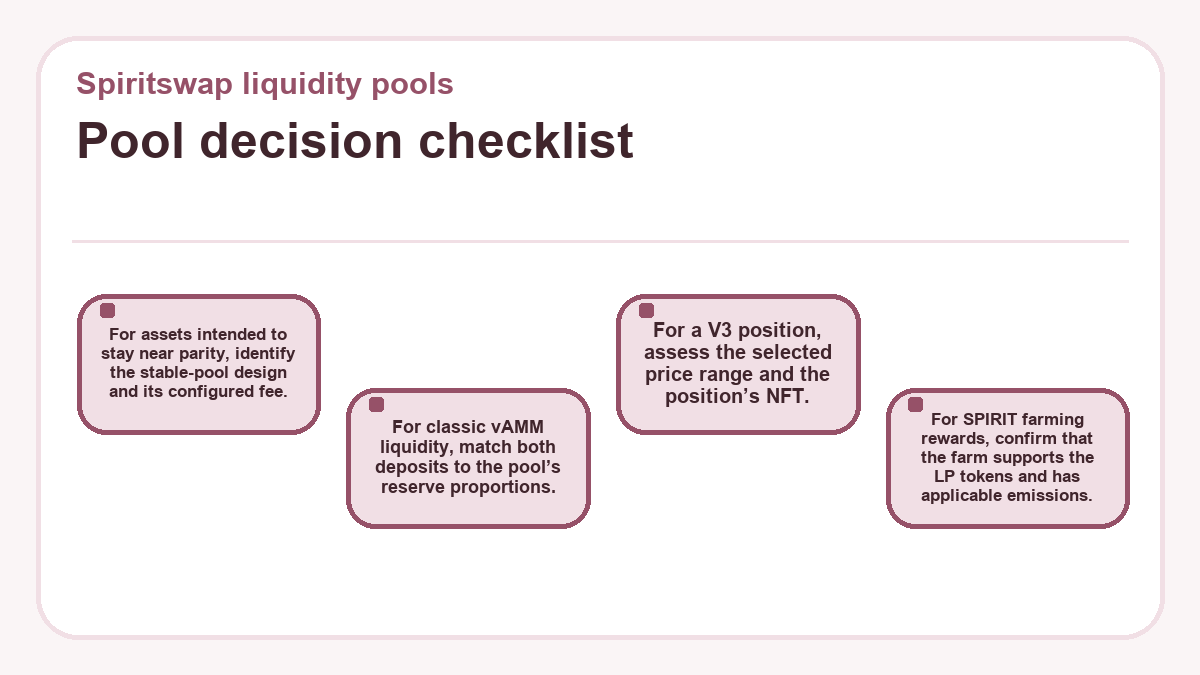
- For assets intended to stay near parity, identify the stable-pool design and its configured fee.
- For classic vAMM liquidity, match both deposits to the pool’s reserve proportions.
- For a V3 position, assess the selected price range and the position’s NFT.
- For SPIRIT farming rewards, confirm that the farm supports the LP tokens and has applicable emissions.